Dropped kerbs and disabled access: discounts, grants and how to apply
There's no national Blue Badge discount or fee waiver for a driveway dropped kerb in the UK, but some councils offer one, and a Disabled Facilities Grant can sometimes pay for a dropped kerb and hardstanding. Below: real council examples, grants, disabled bays, blocked kerbs, gradients and a free supporting letter.
Last reviewed: Page updated: Edited by our editor
Quick answer. A driveway dropped kerb goes through the same council application whether or not you're disabled. A few councils give Blue Badge holders a discount, a free application or relaxed rules: for example Enfield (no application fee), Kingston (£100 off building costs) and West Northamptonshire (some criteria relaxed). If you need off-street parking because of a disability, ask your council about a Disabled Facilities Grant: some councils' grant policies include a dropped kerb and hardstanding for wheelchair users. A disabled parking bay on the road is the main alternative, and a pedestrian dropped kerb (a crossing point) is a different request again.
General information, not legal or financial advice. Your council's own policy is what applies to you.
Blue Badge holders: discounts and relaxed rules
A dropped kerb (vehicle crossing) needs your highway authority's permission (GOV.UK). There's no national discount for disabled applicants: it's each council's choice. Only a handful of the 202 council dropped kerb pages in our database mention a Blue Badge concession. These are the ones we found, each checked on the council's own website on 14 October 2026:
| Council | What it offers | What it asks for |
|---|---|---|
| Enfield | Application fee (£301, non-refundable) is free for Blue Badge holders | A copy of both sides of your Blue Badge with the application (source) |
| Kingston upon Thames | £100 off the construction cost if the application succeeds; the crossover fee is refunded to Blue Badge holders if the application is refused; the limit on grass verge loss is extended to 3 metres | Tell the council about your Blue Badge after approval; you can make an initial enquiry with a copy of your badge first. It may consider a disabled bay as an alternative (source) |
| Birmingham | Blue Badge holders may be eligible for a discount on building a standard 2.75 m wide dropped kerb at the address where the badge or benefit is registered | Tick the box on the form; you'll be asked for both sides of the badge and proof of address, such as a GP or hospital letter, utility bill (not a mobile phone bill) dated within 3 months, driving licence or benefit award (source) |
| West Northamptonshire | Some of its dropped kerb criteria can be relaxed if a resident holds a valid Blue Badge | Additional work may be needed for an access to be built (source) |
| Cambridgeshire | Blue Badge holders may be eligible for a free access protection (H-bar) marking | Pay on application; it may be refunded depending on eligibility and available funds (source) |
| Neath Port Talbot | Allows for a wider drive: more than 2.6 m wide at all points, or 3.6 m for disabled access | Part of its driveway size rules (source) |
One council works the other way: Plymouth says you won't qualify for off-street parking if you have a disabled driver's parking bay (source). If your council isn't listed, look at its dropped kerb page on our council finder, or ask: a polite letter using our free supporting letter template costs nothing. Don't assume a discount exists until the council confirms it in writing.
Getting a Blue Badge
Many councils' concessions depend on a Blue Badge, so it helps to have one first. According to the Department for Transport, you automatically qualify if you're aged 3 or over and, for example, you get the higher rate of the mobility component of Disability Living Allowance, you get Personal Independence Payment because you can't walk more than 50 metres (8 points or more under 'moving around'), you're registered blind (severely sight impaired), or you get a War Pensioners' Mobility Supplement. Others may qualify after an assessment, for example if you can't walk without help or mobility aids, find walking very difficult because of pain, breathlessness or the time it takes, or struggle severely to plan or follow a journey.
- Apply through GOV.UK (England, Scotland and Wales) or nidirect in Northern Ireland. You'll need proof of identity, proof of address and a recent head-and-shoulders photo.
- Cost: up to £10 in England and £20 in Scotland; free in Wales (GOV.UK).
- Time: your council decides, and the DfT says it may take 12 weeks or longer.
A Blue Badge is about parking, not driveways: it doesn't give you a right to a dropped kerb, and it doesn't let you park across one (see below).
Disabled Facilities Grants: can they pay for a dropped kerb?
A Disabled Facilities Grant (DFG) is a council grant for changes to a disabled person's home. GOV.UK gives examples including widening doors and installing ramps, improving access to rooms and facilities, and improving access to your garden. It's open to people with physical disabilities, learning disabilities, age-related needs, autism, dementia and other conditions, and it doesn't affect your benefits.
- How much: up to £30,000 in England, £36,000 in Wales and £25,000 in Northern Ireland; DFGs aren't available in Scotland. It's usually means-tested on household income and savings over £6,000, though disabled children under 18 can get a grant without their parents' income being counted (GOV.UK).
- Who applies: the owner, tenant or landlord, and the disabled person must intend to live there for the grant period, usually 5 years. The council must be satisfied the work is necessary and appropriate, and reasonable and practicable (GOV.UK).
- Don't start work first. GOV.UK warns you might not get any grant if you start before the council approves your application. Planning permission and building regulations approval are separate.
What council grant policies say about dropped kerbs
GOV.UK doesn't mention dropped kerbs. Whether a DFG covers one depends on your council's policy, so here's what some of them say:
- Thurrock: its list of works that can generally be considered for a mandatory grant includes hard standings (3.6 m by 4.8 m maximum) and the associated crossover (dropped kerb) where the disabled person is in a wheelchair or has extreme difficulty walking to the house. A dropped kerb wouldn't be considered where a suitable hard standing already exists (policy).
- Thanet (district council, Kent): funds hard standings (3.6 m by 4.8 m maximum) and the associated crossover where the disabled person is in a wheelchair or has difficulty walking to the house, but only where on-street parking is unsatisfactory and a marked disabled parking bay isn't possible, or it's cheaper than extra paths or ramps from the road. It adds that a Blue Badge isn't the eligibility test, and lists dropped kerbs, hard standings and ramps for non-wheelchair users and non-drivers as non-mandatory items it doesn't fund (guidance).
- Runnymede (Surrey): similar wording on hard standings for wheelchair users or people with difficulty walking to the house, and lists dropped kerbs for non-wheelchair users or non-drivers among items outside the mandatory grant (guidance).
- Castle Point and Epping Forest (Essex): their discretionary assistance can include "the provision and installation of a dropped kerb to facilitate access to a hard standing located within the curtilage of the disabled person's dwelling". Castle Point's Special Assistance is up to £15,000 (Castle Point policy; Epping Forest policy).
The common thread: grants are aimed at people who use a wheelchair or have serious difficulty walking to the house, for the land inside your boundary, and often only when a disabled parking bay on the road won't work. In two-tier areas, the grant usually comes from your district council while the dropped kerb permission comes from the county council, so you may deal with two councils.
The occupational therapist's role
An occupational therapist (OT) usually decides what adaptations you need. Runnymede says an OT "will determine that the works are 'necessary and appropriate'"; Epping Forest says each case must be supported by a recommendation from an OT working with Essex County Council Social Services; Thurrock's DFG service works primarily with the council's occupational therapy service; and Thanet says some items are only considered if an OT recommends them. To ask for an assessment, contact your council's adult social care or grants team. An OT report is also useful evidence for a dropped kerb application or a disabled parking bay.
Other funding: Access to Work and Motability
- Access to Work is for getting to and staying in work. GOV.UK lists things like specialist equipment, support workers, travel costs if you can't use public transport, vehicle adaptations and changes to your workplace (which can include your home if you work from there). Driveways and dropped kerbs aren't on its list, so don't count on it.
- Motability: Motability says that if you have a driveway, your first electric car lease includes a home charger and standard installation; if you don't, you get a bp pulse public-charging subscription instead. A dropped kerb is what lets you use a front driveway legally, so it can make a difference to how you charge. See EV charging without a driveway.
Disabled parking bays or a dropped kerb?
If you can't get a dropped kerb, or can't afford one, a disabled parking bay on the road outside your home is the usual alternative. They're quite different:
| Disabled parking bay (on the road) | Dropped kerb (driveway) | |
|---|---|---|
| Who can use it | Any Blue Badge holder, not only you (Leeds) | You and anyone you allow, on your own land |
| Enforcement | Some are advisory only: Reading's are "not legally enforceable" and West Northamptonshire's sign and line can't be enforced by the council or police | Parking that blocks it can get a penalty charge in areas with civil parking enforcement |
| Cost | Varies: free in Leeds; £78 non-refundable application in Reading plus a quote; £245 for sign and line in West Northamptonshire (£415 if a post is needed) | Council fees plus building costs: see dropped kerb costs |
| Typical evidence | Blue Badge; often a mobility award (Leeds: higher-rate DLA mobility or 8+ PIP points for moving around) and vehicle registration (V5C), or Motability paperwork | Application form, plan, fee; Blue Badge if you're claiming a concession |
Leeds consults your neighbours for three weeks and says a decision takes a minimum of 12 weeks; valid objections can stop a bay (Leeds). Reading requires that you hold a Blue Badge, live at the address, own the car or have it registered there, have no parking restrictions outside other than residents-only parking, and can't walk more than short distances (Reading). West Northamptonshire wants the form countersigned by a professional such as a doctor, health visitor or occupational therapist (West Northamptonshire). If your driveway is blocked by other cars, an H-bar marking is another option.
Pedestrian dropped kerbs and tactile paving
A pedestrian dropped kerb (crossing point) is different from a driveway one: it's lowered flush with the road so wheelchair, mobility scooter and pram users can cross, with tactile (blister) paving for people with a visual impairment. A driveway crossover keeps a small upstand and usually has no tactile paving.
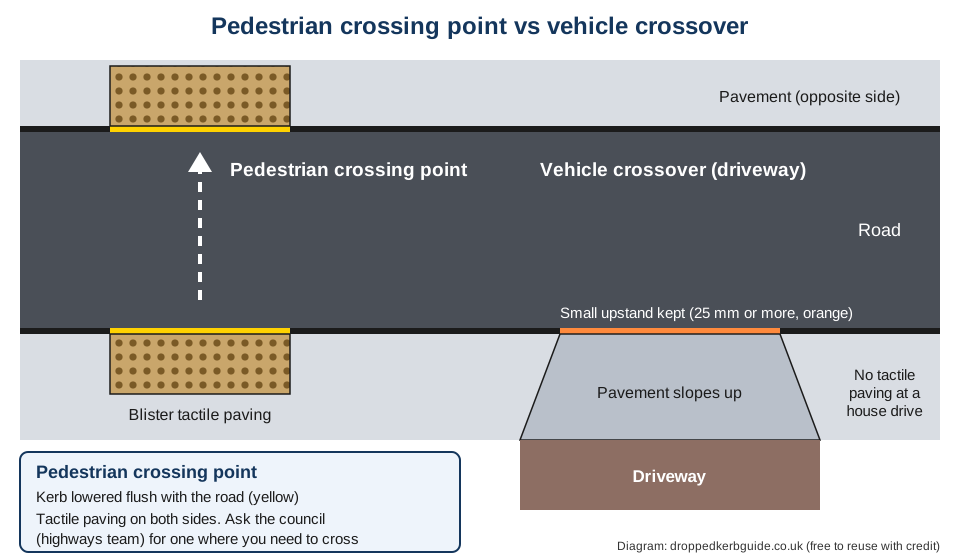
You can ask your council for one where you need to cross. Leeds, for example, prioritises places where disabled people have no suitable alternative route. Full details in our guide: requesting a pedestrian dropped kerb.
When someone blocks a dropped kerb
- Highway Code rule 243 tells drivers not to stop or park "where the kerb has been lowered to help wheelchair users and powered mobility vehicles", and in Scotland you MUST NOT park anywhere the kerb has been lowered to help pedestrians or cyclists (Highway Code).
- Penalty charges in England and Wales: where the council runs civil parking enforcement, section 86 of the Traffic Management Act 2004 bans parking next to a dropped footway, with no yellow lines needed. There are exceptions, including for the occupier at a single-property driveway.
- Scotland: section 56 of the Transport (Scotland) Act 2019 bans parking at dropped footways.
- Pavement parking: rule 244 says you MUST NOT park partly or wholly on the pavement in London or Scotland, and notes it can seriously inconvenience people in wheelchairs, with visual impairments and with prams or pushchairs.
- Blue Badge holders aren't exempt: the DfT's Blue Badge guidance says not to park where the kerb has been lowered or the road raised to help wheelchair users.
To report it, contact your council's parking enforcement team (in London, Transport for London for red routes). More detail, including the exceptions: parking across a dropped kerb.
Wheelchair-friendly gradients and surfaces
There's no single legal gradient for a private driveway, but the Department for Transport's Inclusive Mobility guidance for public pedestrian routes is a useful benchmark when you talk to a builder:
- Level means no gradient steeper than 1 in 60. If that isn't possible, slopes shouldn't exceed 1 in 20; 1 in 12 is the absolute maximum, and steeper slopes risk a wheelchair tipping.
- Crossfall (sideways slope for drainage): preferably 1 to 2 per cent (up to 1 in 50), with 1 in 40 the maximum.
- Surface: keep it smooth; even small dips or gaps in paving joints can be a hazard for people using a stick or crutch.
- Width: some councils allow wider drives for disabled access, such as Neath Port Talbot's 3.6 m.
The dropped kerb itself must be built to your council's specification. If you're paving the front garden, check the planning rules on hard surfaces in our guide to paving a front garden.
How to apply, step by step
- Find your highway authority with the postcode checker and read its dropped kerb page for any Blue Badge or disability concession.
- Check you're likely to qualify on space, visibility and obstructions with our eligibility checker and dropped kerb rules. Ask whether criteria can be relaxed for disabled access, as West Northamptonshire does.
- If you may need a grant, talk to the council first. Ask adult social care for an OT assessment and the grants team about a Disabled Facilities Grant before any work starts.
- Check planning permission if you're on a classified road, in a flat, a listed building or a conservation area: see planning permission.
- Gather your evidence: both sides of the Blue Badge, proof the badge holder lives there (Birmingham lists a GP or hospital letter, a utility bill dated within 3 months, a driving licence or a benefit award), any OT report or professional's letter, a site plan, photos, and the landlord's consent if you rent.
- Apply and ask in writing for any concession or priority, using our supporting letter. Keep copies and reference numbers. Follow the full application guide.
Free supporting letter template
Our disability supporting letter / priority request (Word and PDF) asks the council to consider a fee waiver, discount, relaxed criteria or priority, and explains why off-street parking matters for the disabled person. It has an optional section for an OT, GP or other professional to sign. It's free, with no sign-up. See all our free dropped kerb templates.
Download Word (.docx) Download PDF
Scotland, Wales and Northern Ireland
- Scotland: Disabled Facilities Grants aren't available (GOV.UK); ask your council about help with adaptations. A Blue Badge costs up to £20, and parking at dropped footways is banned under the Transport (Scotland) Act 2019.
- Wales: a DFG can be up to £36,000, and a Blue Badge is free. Section 86 of the Traffic Management Act 2004 applies where councils enforce parking.
- Northern Ireland: a DFG can be up to £25,000; apply for a Blue Badge on nidirect. Driveway access is approved by DfI Roads: see Northern Ireland dropped kerbs.
Questions people ask
Do Blue Badge holders get a free dropped kerb?
Not as a national rule. GOV.UK's dropped kerb guidance doesn't mention a Blue Badge concession, and it's up to each council. Some councils do help: Enfield waives its £301 application fee for Blue Badge holders, Kingston offers £100 off the construction cost and refunds the fee if a Blue Badge holder's application is refused, and Birmingham says Blue Badge holders may be eligible for a discount on a standard 2.75 m crossing. Check your own council's page.
Can a Disabled Facilities Grant pay for a dropped kerb?
Sometimes. GOV.UK says the grant can help improve access to your home and garden, and some councils' policies name a dropped kerb or hardstanding. Thurrock lists a hard standing (3.6 m by 4.8 m maximum) and the associated dropped kerb where the disabled person uses a wheelchair or has extreme difficulty walking to the house. Others limit it: Thanet and Runnymede only fund a hard standing where on-street parking is unsatisfactory and a disabled parking bay isn't possible or would cost more, and exclude dropped kerbs for people who aren't wheelchair users or drivers. Ask your council's grants team before you start any work.
Does a Blue Badge let me park across a dropped kerb?
No. The Department for Transport's Blue Badge guidance says the badge isn't a licence to park anywhere and tells holders not to park where the kerb has been lowered or the road raised to help wheelchair users. In areas with civil parking enforcement, parking next to a dropped footway can get a penalty charge notice.
Is a disabled parking bay outside my house enforceable?
It depends on the council. Reading says its disabled parking boxes are advisory only and not legally enforceable, and West Northamptonshire says its sign and line can't be enforced by highway authority staff or the police. Any Blue Badge holder can use a bay, not just the person who applied (Leeds).
Who can write a supporting letter for my dropped kerb application?
Councils that ask for evidence usually want something from a professional who knows about your mobility. West Northamptonshire, for its disabled parking space form, asks for a countersignature from a professional such as a doctor, health visitor or occupational therapist. Our free supporting letter template has space for one. Some GP practices charge for this, as West Northamptonshire notes.
How do I get a dropped kerb so I can cross the road in my wheelchair?
Ask your council's highways team for a pedestrian dropped kerb. Leeds, for example, has an online form and prioritises places with no suitable alternative route; Plymouth needs approval from your local councillors and has a limited budget for each ward. See our guide to requesting a pedestrian dropped kerb.
Can I get help if I'm getting an electric car through Motability?
Motability says that if you have a driveway, your first electric car lease includes a home charger and standard installation; without one, you get a bp pulse subscription instead. A dropped kerb is what lets you use a front driveway legally, so it may be worth applying before you choose. Motability doesn't say it pays for the dropped kerb itself.
Sources (official, checked 14 October 2026)
- GOV.UK: Apply for a dropped kerb
- GOV.UK: Apply for or renew a Blue Badge
- GOV.UK (DfT): Can I get a Blue Badge?
- GOV.UK (DfT): The Blue Badge scheme: rights and responsibilities in England
- nidirect: Blue Badge scheme (Northern Ireland)
- GOV.UK: Disabled Facilities Grants, overview
- GOV.UK: Disabled Facilities Grants, what you'll get
- GOV.UK: Disabled Facilities Grants, eligibility
- GOV.UK: Access to Work, what you'll get
- Motability Scheme: cars available with no or low Advance Payment (home charger with a driveway; prices valid 1 October to 31 December 2026)
- The Highway Code: Waiting and parking (rules 238 to 252), rules 243 and 244
- Traffic Management Act 2004, section 86 (parking at dropped footways)
- Transport (Scotland) Act 2019, section 56 (dropped footway parking prohibition)
- DfT: Inclusive Mobility, a guide to best practice on access to pedestrian and transport infrastructure (December 2021), PDF
- DfT: Guidance on the use of tactile paving surfaces (published 10 January 2022), PDF
- GOV.UK (DfT): Inclusive mobility: using tactile paving surfaces
- Enfield Council: Dropped kerbs for vehicles
- Royal Borough of Kingston upon Thames: Cost of applying for a dropped kerb (Blue Badge holders)
- Birmingham City Council: Apply for a dropped kerb, costs (discounts for Blue Badge holders)
- West Northamptonshire Council: Apply for a dropped kerb
- West Northamptonshire Council: Apply for a disabled parking space outside your house
- Cambridgeshire County Council: Dropped kerbs and access protection markings
- Neath Port Talbot Council: Apply for a dropped kerb
- Plymouth City Council: Dropped kerbs (including crossings for wheelchairs and mobility scooters)
- Reading Borough Council: Dropped kerbs, APMs and disabled boxes
- Leeds City Council: Request a disabled parking bay outside a property
- Leeds City Council: Report the need for an accessible kerb in your local area
- Thurrock Council: Disabled Facilities Grant and Housing Assistance Policy (PDF)
- Thanet District Council: What can I use a disabled facility grant for?
- Runnymede Borough Council: Disabled Facilities Grants guidance (PDF)
- Castle Point Borough Council: Disabled Facilities Grant Policy, Cabinet report 22 April 2026 (PDF)
- Epping Forest District Council: Housing Assistance Policy 2025 (PDF)