H-bar markings: white lines across your dropped kerb
Last reviewed: Page updated: Edited by our editor
Quick answer. An H-bar is a white H-shaped line painted on the road across a dropped kerb, officially an "access protection marking". It's an advisory marking: councils that offer them say they can't be enforced on their own. Many councils will paint one for a fee (from £78 to £259 in the examples below), but some, like Southwark, no longer install them. Parking across a dropped kerb can be a parking contravention with or without the marking.
On this page
What an H-bar marking is
The H-bar is diagram 1026.1 in the Traffic Signs Regulations and General Directions 2016, listed in Schedule 11 Part 4 under advisory road markings. Its official description is: part of the carriageway "outside a vehicular entrance to adjacent premises or a private drive, or where the kerb is dropped to provide a convenient crossing place for pedestrians, which should be kept clear of waiting vehicles".
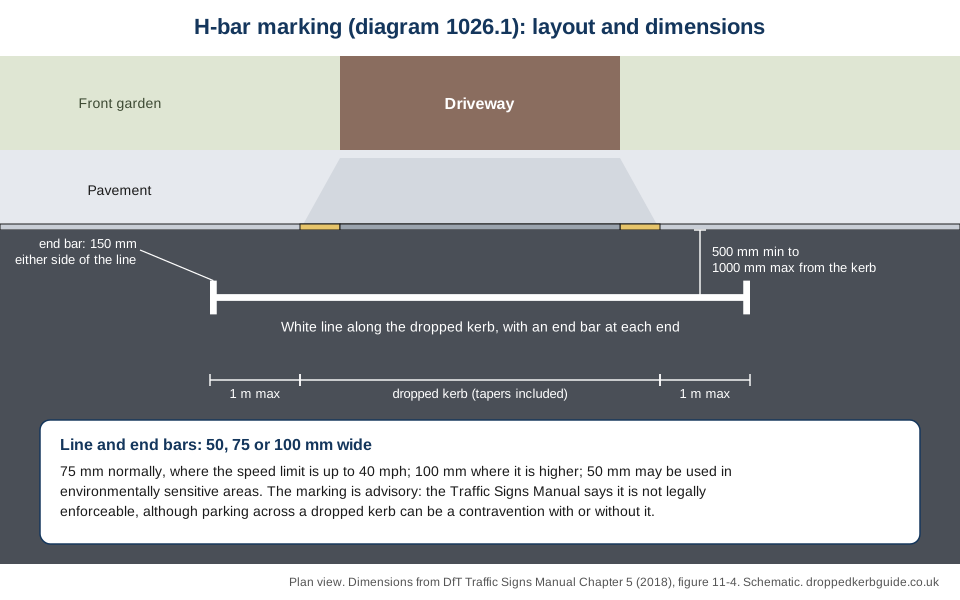
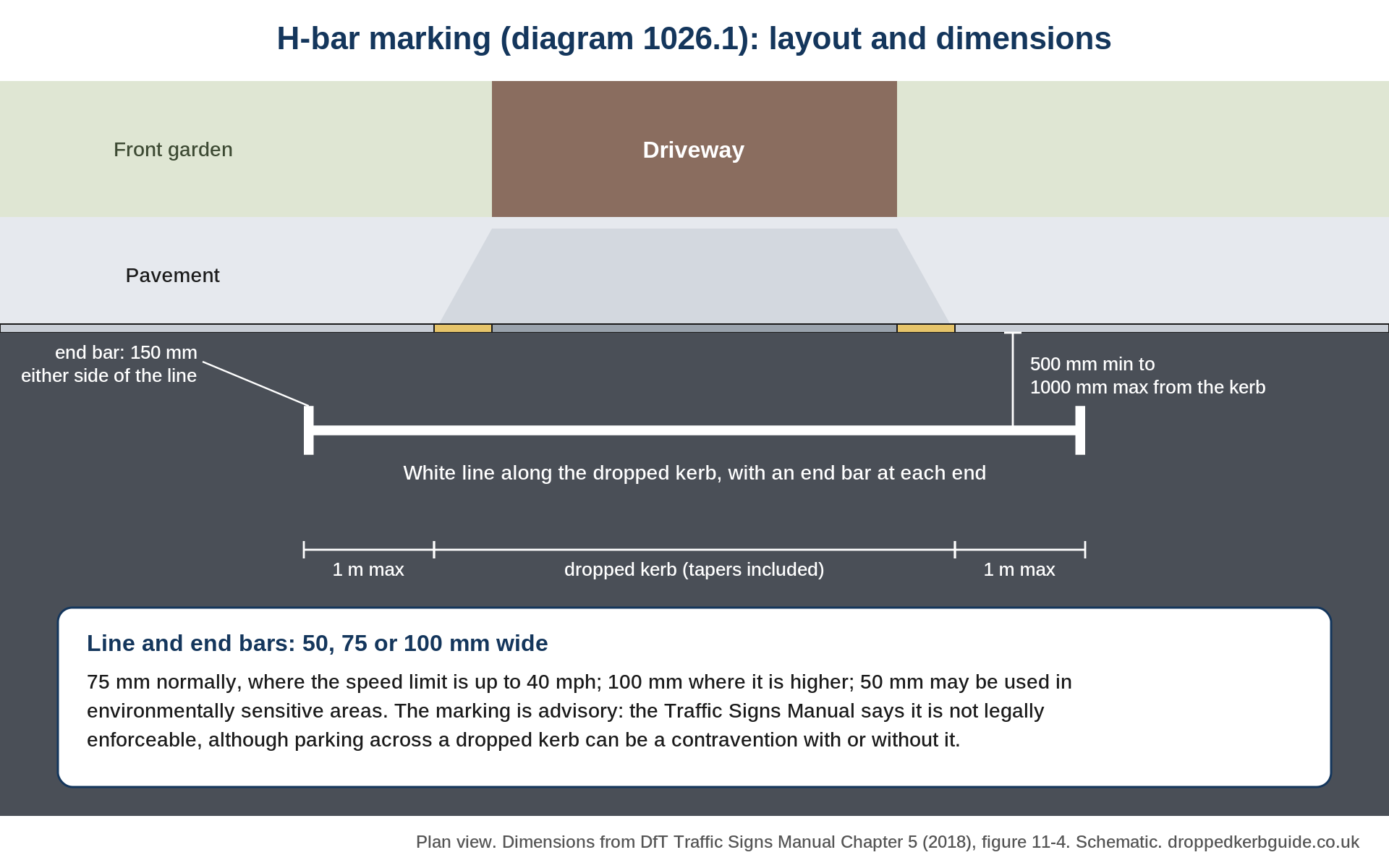
Councils call it an access protection marking (APM), an H-bar or an H marking. It's usually a single white line along the length of the dropped kerb with a short bar at each end.
The Department for Transport's Traffic Signs Manual gives the layout: the line sits 500 mm to 1000 mm out from the kerb, and the end bars extend 150 mm either side of it. The marking should normally be 75 mm wide where the speed limit is up to 40 mph and 100 mm where it's higher (50 mm may be used in environmentally sensitive areas), and it shouldn't extend more than 1 m either side of the dropped kerb.
Can an H-bar be enforced?
Not on its own. Milton Keynes says its markings "are advisory and are not enforceable", and Reading says they're "advisory markings only and are not enforceable in law". Warrington says it can't issue parking tickets just because someone parks on an H-bar.
That doesn't mean parking across your drive is allowed. Where a council runs civil parking enforcement, section 86 of the Traffic Management Act 2004 bans parking next to a dropped kerb whether or not there's a marking, subject to exceptions. The North Essex Parking Partnership says traffic signs and road markings "are not required". See is it illegal to park on a dropped kerb? for the rules and how to report it.
What councils charge
These are examples from council websites, checked on 6 October 2026. Fees change, so check your own council.
| Council | Fee | Notes |
|---|---|---|
| Cambridgeshire | £259 | Full refund if unsuccessful. Blue Badge holders may get one free, depending on eligibility and funding. |
| Milton Keynes | £223 per application | Offered at the council's discretion. Applicant pays all costs, including ongoing maintenance such as repainting. |
| Warrington | £132 new or extended; £52.80 renewal | Full refund if the application isn't approved; no refund if you cancel after paying. |
| Reading | £78 application fee (non-refundable) | Site visit, then a separate quote for the work if approved. |
| Southwark | Not offered | No longer installs H-bars, which it considers unnecessary street clutter. |
Common conditions
- You need a dropped kerb. Reading, for example, offers APMs if you have a dropped kerb (footway crossing).
- Not where there are yellow lines. Reading won't paint an APM where there are yellow lines in front of the dropped kerb.
- Discretionary. Milton Keynes says APMs aren't a compulsory service and are offered at its discretion. It paints approved markings in batches, usually within 8 weeks.
- Shared dropped kerbs and other limits. Warrington won't install an H-bar where two or more properties share the dropped kerb and not all the residents agree, next to or within a junction controlled by traffic lights, near a pedestrian crossing, or where there isn't a dropped kerb.
How to apply
H-bars are usually handled by the highway authority's highways or parking team, so in two-tier areas that's the county council. Use find your council to get to the right authority, then search its website for "access protection marking" or "H bar". If you don't have a dropped kerb yet, start with how to apply for a dropped kerb.
Sources (official, checked 6 October 2026)
- Traffic Signs Regulations and General Directions 2016, Schedule 11 Part 4 (advisory road markings, diagram 1026.1)
- Department for Transport: Traffic Signs Manual Chapter 5, Road Markings (2018), section 11.4 and figure 11-4 (PDF) (checked 19 November 2026)
- Traffic Management Act 2004, section 86
- North Essex Parking Partnership: Enforcement at dropped kerbs (reviewed September 2025)
- Cambridgeshire County Council: Dropped kerbs and access protection markings
- Milton Keynes City Council: Access protection markings
- Warrington Borough Council: Apply for access protection marking (H bar)
- Reading Borough Council: Dropped kerbs, APMs and disabled boxes
- Southwark Council: Dropped kerbs and driveways