Permeable driveways in the UK: rules, options and soakaways
A permeable driveway lets rain soak through into the ground instead of running into the drains or onto the road. Below: when the law requires one in each UK nation, the options (from gravel to permeable block paving), soakaway driveways, what goes underneath, and the drainage rules councils set for a new dropped kerb.
Last reviewed: Edited by our editor
Quick answer. A permeable driveway lets rainwater soak through it, for example gravel, permeable block paving or porous asphalt over an open-graded sub-base. In England, at a house, you don't need planning permission for a driveway of any size that is permeable or drains onto a lawn or border within your property; an impermeable front driveway over 5 square metres that drains to the road or a drain does need it. Wales and Scotland apply the rule without the 5 square metre threshold for new surfaces. Separately, many councils won't approve a dropped kerb unless water from the driveway is kept off the pavement and road.
What makes a driveway permeable
The government's guidance on the permeable surfacing of front gardens describes a permeable surface as any surface that lets water soak through it: porous materials such as gravel, porous concrete or porous asphalt, or impermeable materials "laid with gaps between blocks". It gives three main types of solution:
- gravel or a mainly green, planted area;
- a hard, impermeable surface that drains to a border, rain garden or soakaway;
- permeable block paving, porous asphalt or porous concrete.
The surface is only half of it. Both permeable and ordinary driveways sit on a sub-base that stops the car rutting the ground, and a permeable drive needs a different sub-base that lets water pass through and stores it until it can soak away (see what goes underneath).
Why it matters: the guidance says paving over front gardens sends more rainwater into drains that weren't designed for it, raising the risk of flooding, and washes oil, petrol and brake dust into streams and rivers. That is why the planning rules in England changed on 1 October 2008.
When the law requires a permeable driveway
Laying a driveway at a house is normally "permitted development", so you don't need to apply for planning permission, but each nation attaches a drainage condition to the part of the garden in front of the house. If your driveway doesn't meet it, you need planning permission.
| Nation | Which surfaces the rule covers | What the surface must do | Law |
|---|---|---|---|
| England | Hard surface between the front wall of the house and a highway, over 5 m² (new or replaced) | Porous materials, or run-off directed to a permeable area within the property | GPDO 2015 Part 1 Class F |
| Wales | Any new hard surface in front of the house and between it and a highway; replacing more than 5 m² of existing surface (counting other replacements in the previous 6 months) | Porous or permeable, or run-off directed to a porous or permeable area within the property, and permanently maintained that way. Not permitted development within the grounds of a listed building | GPDO 1995 Part 1 Class F, GOV.WALES |
| Scotland | Any hard surface between the house and a road bounding its grounds, whatever the size | Porous materials, or run-off directed to a permeable or porous area within the property. Not permitted development in a conservation area or within the grounds of a listed building | GPDO (Scotland) 1992 Class 3C |
| Northern Ireland | Hard surface between the front wall of the house and a road, over 5 m² (new or replaced) | Porous or permeable materials, or run-off directed to a porous or permeable area within the property | GPDO (NI) 2015 Part 1 Class E |
The Planning Portal sums up the English rule: you won't need planning permission if "a new or replacement driveway of any size uses permeable (or porous) surfacing", or if the rainwater is directed to a lawn or border to drain naturally. The rights are for houses: in England a "dwellinghouse" doesn't include a flat (GPDO 2015, article 2), and rights can be removed by an article 4 direction or a condition on an earlier planning permission. For flats, listed buildings and other exceptions, see do you need planning permission for a driveway?
If you do need to apply, the 2008 guidance's fee of £150 is long out of date. In England, planning fees are set nationally and are uprated for inflation on 1 April each year; the current figures are on the government's fees for planning applications page.
Your dropped kerb and the driveway's drainage
A permeable driveway and a dropped kerb are separate permissions. Planning rules decide what you can lay in your garden; to drive across the pavement you also need the highway authority's consent for a dropped kerb (in England and Wales under section 184 of the Highways Act 1980). The government's guidance makes the same point: for a new access across the footway you need the council's permission to drop the kerbs.
But the two meet at the boundary. Water running off a driveway onto the pavement is the highway authority's concern, and many councils set drainage or surface rules for the parking area before they'll approve or build a crossing:
| Council | What the council says about the driveway |
|---|---|
| Manchester | All driveways must be installed using permeable material. (source) |
| Nottingham | The parking area must be made from permeable, bound materials. Loose gravel is not permitted. (source) |
| Redbridge | Surface water must not drain into the public highway. Permeable (or porous) surfacing such as permeable block paving or porous asphalt, with a permeable base; a drainage channel across the whole threshold, draining to a soakaway; no shingle, gravel or pebbles. The crossing isn't built until an approved parking area is in place. (source) |
| Milton Keynes | Won't formally permit a crossing until a permeable hardstanding has been built on the property, which you arrange yourself before applying. (source) |
| Suffolk | Only bound surfaces in the highway and for the first 5 metres inside your property (or a depth agreed if less). Surface water run-off from the property onto the highway is not permitted. (source) |
| Warwickshire | Where the driveway slopes down towards the highway, positive drainage must be installed to stop surface water reaching it. (source) |
| Wakefield | A pebble driveway needs a 2-metre hard standing in a different material; a driveway sloping down towards the pavement needs drainage. (source) |
| Northumberland | The parking area must be built so that water doesn't drain from it across the footway, with suitable drainage inside your property. (source) |
Highway authorities also have legal powers. In England and Wales, section 163 of the Highways Act 1980 lets the highway authority (or the local authority) serve a notice requiring the occupier of premises next to a highway to build and maintain channels, gutters or downpipes to prevent, so far as reasonably practicable, surface water from the premises flowing onto or over the footway. The notice gives 28 days, and you can appeal to a magistrates' court. In Scotland, section 99 of the Roads (Scotland) Act 1984 requires the owner and occupier of land to prevent any flow of water from it onto the road, and the roads authority can serve a notice requiring works.
So plan the drive and the crossing together: check your council's conditions in dropped kerb rules and sizes or on your council's page, then apply. Some councils, such as Milton Keynes and Redbridge, won't build or permit the crossing until the parking area is in place. The crossing itself, across the pavement, is surfaced to the council's specification, not yours (see who chooses the crossing surface).
Permeable driveway options compared
The guidance says the right construction depends on the space, slopes, the type of soil and whether the garden already gets waterlogged, and that the methods can be combined in one garden.
| Option | What it is | Pros | Cons |
|---|---|---|---|
| Loose gravel | Gravel or shingle over a sub-base. A strip of block paving or asphalt at the entrance can limit gravel spreading. | Simple and cheap; materials easy to get; easy to combine with planting | Scatters or forms waves; not for steep drives; not suitable for wheelchairs |
| Wheel tracks | Two paved strips where the wheels go, typically 300 mm to 600 mm wide each, on a sub-base, with gravel or planting between and around them. Water must drain from the tracks into the permeable area. | Simple and cheap; keeps hard surface to a minimum | Needs regular maintenance to look tidy |
| Reinforced grass or gravel | Plastic or concrete reinforcement that lets cars drive on grass (or gravel, with plastic systems) without rutting. | Attractive; can help reduce temperatures, absorb pollution and dust and reduce noise | May need mowing; grass may die where a car is parked for long periods; gravel may need sweeping on a slope |
| Permeable block paving, porous asphalt or porous concrete | Hard surfaces with open voids, or gaps around the blocks, laid over a permeable sub-base. | Hard and durable with a very long life if built correctly; the least maintenance | Can cost more; needs a knowledgeable contractor (porous asphalt should be laid by a specialist) |
| Ordinary surface draining to a rain garden, border or soakaway | Conventional asphalt, concrete or block paving, with the run-off directed to a planted hollow, a border, or a gravel trench or crate soakaway. | Lets you use conventional materials; can be an attractive feature | Deeper digging and more space; needs suitable (sandy or gravelly) ground and a knowledgeable contractor |
Thinking of tarmac? See permeable tarmac driveways (porous asphalt) for how it differs from ordinary tarmac, what councils ask for and how it's built.
The guidance also suggests water butts and underground rainwater tanks as a complement to these methods, not a replacement: a harvesting system still needs an overflow to a soakaway or drain.
What goes underneath
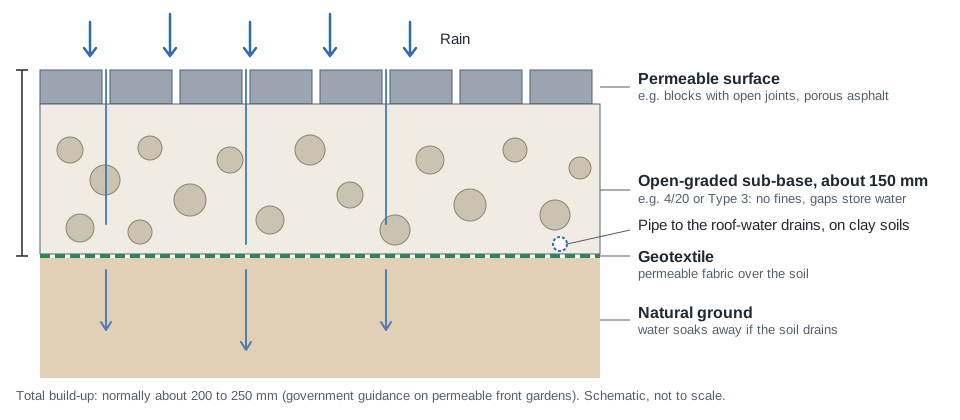
According to the government's guidance:
- Depth. There will normally be about 200 mm to 250 mm of material from the surface of the drive down.
- Sub-base. Ordinary drives use hardcore or "MOT Type 1", which has a lot of fine material in it and stops water passing through easily. A permeable drive needs an open-graded sub-base made only of larger stones with space between them, such as 4/20 or Type 3 sub-base. About 150 mm is laid and compacted, like a normal sub-base.
- Geotextile. A permeable fabric goes over the soil at the bottom, to stop the sub-base sinking into the soil and help prevent weeds.
- Ground strength. If it's hard to drive a 50 mm square wooden peg more than 150 mm into the ground, the soil is strong enough to support the drive. If it goes in easily, the ground may be too soft and you need expert advice. Softer patches found while digging out should be dug out and refilled with sub-base.
- Draining to a rain garden or soakaway instead? Then the driveway itself can be built with traditional impermeable materials.
The guidance recommends an experienced landscape or driveway contractor, and says casual jobbing contractors who knock on your door offering to lay a driveway should not be used to build permeable driveways. For the crossing over the pavement, see choosing a dropped kerb contractor.
Will your ground drain?
- Soil type. The soil under the drive or rain garden should be sandy or gravelly, not clay, otherwise a connection to the drains may be needed.
- The pit test. As a rule of thumb, a pipe will be required if a water-filled pit 300 mm by 300 mm by 300 mm takes more than 11 hours to empty.
- Clay soils. It's a wise precaution to include a pipe in the sub-base that drains to the roof drains, so water doesn't sit in the sub-base. The guidance says the permeable surface still helps, because the water soaks into the surface and is stored underground before it reaches the pipe.
- Waterlogged gardens. If the garden is already waterlogged, the sub-base will need draining by a pipe connected to the drains.
- Contaminated land. On a site contaminated by earlier uses, the shallow soils may have been designed to stop water soaking in. Then the paved area has to connect to the drains, though a more specialist permeable construction can still be used.
Soakaway driveways
A soakaway driveway is one of the three methods in the government's guidance: a hard surface (ordinary asphalt, concrete or block paving) that drains to a soakaway, rain garden or border within your property, so the rainwater soaks into the ground instead of running onto the road. It is an alternative to a fully permeable surface such as permeable block paving or porous asphalt. In England, at a house, either approach can avoid the need for planning permission that would otherwise apply to an impermeable front driveway over 5 square metres that drains to the road or a drain.
A soakaway is typically a gravel trench or a crate-filled pit that temporarily holds water and lets it percolate into the soil. The government's guidance says soakaways and rain gardens should not be close to building foundations: for small driveways a minimum of 3 m should be suitable, but it depends on the ground and more may be needed; ask your council's building control department if you are unsure. The ground needs to be suitable (sandy or gravelly soils drain; heavy clay may not). Councils such as Redbridge require a drainage channel across the whole threshold, draining to a soakaway, so that surface water does not reach the public highway. That highway-drainage rule is separate from planning permission, and it often applies whether or not you need planning for the surface itself.
Slopes and other checks
- Slope. The guidance says to slope the drive away from the house, towards the road, wherever possible. A drive steeper than 1 in 20 may not be suitable for permeable surfacing; an impermeable surface draining to a soakaway or rain garden (or, as a last resort, to the roof-water drains) can be used instead. Don't direct water towards a neighbour's property.
- Water heading for the pavement. If the drive falls towards the road, councils such as Warwickshire and Wakefield require drainage to stop the water reaching the highway, and Redbridge requires a drainage channel across the whole threshold draining to a soakaway.
- Drive falling towards the house. Use a drainage channel to collect excess water and connect it to the drains that take the roof water.
- Soakaways and rain gardens shouldn't be close to building foundations. For small driveways a minimum of 3 m should be suitable, but it depends on the ground and more may be needed; ask your council's building control department if you're unsure.
- Underground services. Make sure there are no water pipes, cables or other services close to the surface where you're digging.
- Converting an existing drive. Ask a builder first: the drive may also be taking water from the roof.
Checking it works, and looking after it
When the paving is finished, the guidance's test is a hosepipe: turn it onto the surface for 1 or 2 minutes. There should be no puddles, and the water should soak straight in without flowing over the surface more than 200 to 300 mm.
| Do | Don't |
|---|---|
| Clear up leaves, mud and litter before they clog the surface | Put soil, sand or similar material on the drive |
| Brush the surface if dirt collects, to reduce the risk of blocking and stop weeds | Mix concrete on the drive, or pour oil or other liquids on it |
| Remove weeds by hand or with a weed burner | Let garden areas drain onto the surface, or use weed killer |
If the surface does block, porous asphalt and porous or permeable concrete blocks can be unclogged with a small vacuum road sweeper or a jet washer. In Wales, the law itself requires a permeable front surface to be permanently maintained so it keeps complying.
SuDS approval in Wales
Permeable pavements, soakaways and rain gardens all appear in the Welsh Government's statutory standards for sustainable drainage systems (SuDS). In Wales, new developments of more than one dwelling, or where the construction area is 100 square metres or more, have needed approval from the council's SuDS Approving Body (SAB) since 7 January 2019 (Welsh Government FAQ). Article 6 of the 2018 Order exempts construction work covering less than 100 square metres, so a driveway smaller than that doesn't need SAB approval. It still has to meet the front garden rule above.
Related guides: driveway planning permission, planning permission for a dropped kerb, how a dropped kerb is installed, kerb types and dropped kerb cost.
Questions people ask
What is a permeable driveway?
A driveway that lets rainwater soak through it into the ground, instead of running off into drains or onto the road. The government's guidance gives three main ways to do it: gravel or a mainly planted surface; a hard surface that drains to a rain garden, border or soakaway; or permeable block paving, porous asphalt or porous concrete laid over an open-graded sub-base.
Do I need planning permission for a driveway that isn't permeable?
In England and Northern Ireland, at a house, you need planning permission if a new or replacement hard surface between the front wall and the road covers more than 5 square metres and is neither porous nor drained to a permeable area within your property. In Wales the condition applies to any new hard surface in front of the house, with an allowance to replace up to 5 square metres of existing surface. In Scotland it applies to any hard surface between the house and the road, whatever its size.
Does gravel count as permeable?
Yes. The government's guidance lists gravel as a permeable surface. But some highway authorities don't want loose stones next to the pavement: Nottingham doesn't permit loose gravel, Redbridge won't accept shingle, gravel or pebbles, Suffolk wants a bound surface for the first 5 metres and Wakefield asks for a 2-metre hard standing in a different material in front of a pebble drive.
Is ordinary block paving permeable?
Not by itself. The government's guidance treats conventional block paving, asphalt and concrete as impermeable surfaces. Permeable block paving is a different system, with gaps that let water through to an open-graded sub-base. Ordinary block paving can still be used without planning permission if the rainwater runs off it to a lawn, border, rain garden or soakaway within your property.
Is a resin driveway permeable?
The government's guidance doesn't name resin surfaces. Whether a resin driveway counts depends on whether the finished surface and the layers under it let water through. Ask the installer to confirm in writing that the whole construction is permeable, or plan for the rainwater to run to a permeable area within your property.
Can my council refuse a dropped kerb because of my driveway's drainage?
Yes, many councils set rules for the parking area behind a new crossing. Manchester says all driveways must use permeable material, Milton Keynes won't permit a crossing until a permeable hardstanding is built, and Northumberland requires the parking area to be built so water doesn't drain across the footway. Check your own council's conditions before you build the drive.
How do I know if my ground will drain?
The government's guidance says the soil under a permeable drive or rain garden should be sandy or gravelly rather than clay, otherwise a connection to the drains may be needed. Its rule of thumb: dig a pit 300 mm square and 300 mm deep and fill it with water. If it takes more than 11 hours to empty, a pipe from the sub-base to the drains will be required.
Do I need SuDS approval for a driveway in Wales?
Not for a driveway covering less than 100 square metres. Sustainable drainage approval from the council's SuDS Approving Body (SAB) has been required in Wales since 7 January 2019 for new developments of more than one dwelling or where the construction area is 100 square metres or more, and the 2018 Order exempts construction work covering less than 100 square metres. The front garden rule still applies.
How do I look after a permeable driveway?
Clear leaves, mud and litter before they clog the surface, brush it if dirt collects and remove weeds by hand or with a weed burner. Don't mix concrete or pile soil or sand on it, pour oil on it, let garden beds wash onto it or use weed killer. The guidance says a blocked porous asphalt or permeable block surface can be cleaned with a small vacuum road sweeper or a jet washer.
Sources (official, checked 29 October 2026)
- GOV.UK: Guidance on the permeable surfacing of front gardens (DCLG, 2008)
- GPDO 2015 (England), Schedule 2 Part 1 Class F: hard surfaces at a house
- GPDO 2015 (England), article 2: interpretation ('dwellinghouse' excludes flats)
- Planning Portal: Paving your front garden, planning permission
- GOV.UK: Fees for planning applications (England)
- GPDO 1995 (applies in Wales), Schedule 2 Part 1 (Class F hard surfaces)
- GOV.WALES: Planning permission: paving your front garden
- GPDO (Scotland) 1992, Schedule 1 Class 3C: hard surfaces
- GPDO (Northern Ireland) 2015, Schedule Part 1 (Class E hard surfaces)
- Sustainable Drainage (Approval and Adoption) (Wales) Order 2018, article 6
- Welsh Government: Statutory standards for sustainable drainage systems (2018, PDF)
- Welsh Government: Sustainable drainage (SuDS), frequently asked questions (2019, PDF)
- Highways Act 1980, section 163: prevention of water falling on or flowing on to highway
- Roads (Scotland) Act 1984, section 99: prevention of flow of water onto roads
- Highways Act 1980, section 184: vehicle crossings over footways and verges
- Manchester City Council: Dropped kerbs, definition and requirements
- Nottingham City Council: Apply for a dropped kerb
- Redbridge Council: Dropped kerbs
- Milton Keynes City Council: Vehicle crossing FAQs (2022, PDF)
- Suffolk County Council: Dropped kerb criteria
- Warwickshire County Council: Apply for a dropped kerb, requirements
- Wakefield Council: Kerb crossing, kerb lowering and access requests
- Northumberland County Council: Dropped kerb