Kerb types for a dropped kerb: bullnose, half battered and dropper kerbs
A dropped kerb is usually a row of low bullnosed kerbs across your driveway opening, with a tapered dropper kerb at each end that slopes up to the full-height kerbs either side. Below: the kerb types and their codes (BN, HB2, SP, DL1/DR1), sizes from a council standard detail, the upstand height and how many kerbs councils use.
Last reviewed: Page updated: Edited by our editor
Quick answer. Councils build a driveway dropped kerb from three kinds of precast concrete kerb: full-height kerbs either side (for example a half battered HB2 kerb, 125 mm x 255 mm), a dropper kerb at each end that tapers down, and low kerbs across the opening (commonly bullnosed, type BN, 125 mm x 150 mm) that keep a small upstand above the road: 25 mm in the council specifications we checked that give a figure. A typical standard crossing is 3 low kerbs plus 2 droppers, about 4.5 m. There's no single national layout: your highway authority's specification decides the kerb types, and you need its permission before any kerbs are changed.
The kerbs in a dropped kerb
When a kerb is "dropped" for a driveway, the full-height kerbs in front of your house are taken up and replaced with lower ones, and the pavement behind them is rebuilt strong enough for a car (see how a dropped kerb is installed). Seen from the road, a standard crossing has three parts. Dudley describes it as five kerbs, 4.57 m long: "one left riser kerb, one right riser kerb and three bull-nose kerbs in the centre designated as the ‘crossing point’".
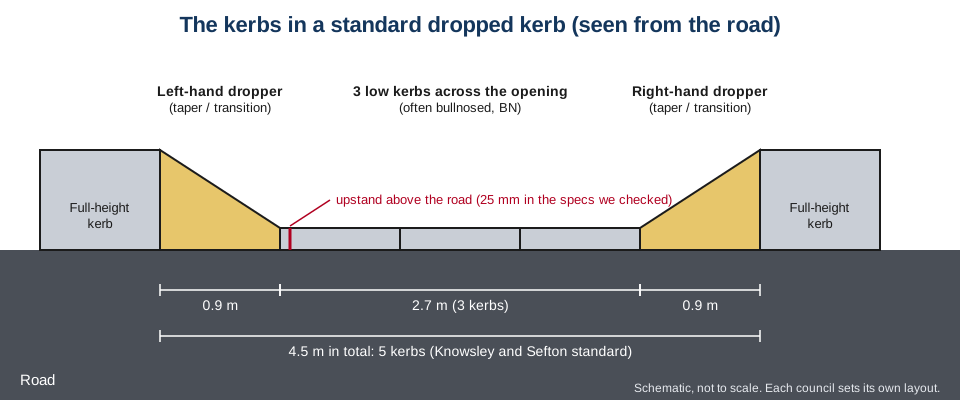
- Full-height kerbs either side stay as they are. On many roads these are half battered kerbs: Coventry's crossing detail labels them "Type HB2 full faced kerbs".
- Dropper kerbs, one left-hand and one right-hand, slope from full height down to the low kerbs. Bath and North East Somerset calls them "dropper kerbs (tapered kerbs)".
- Low kerbs fill the opening you drive over. They're often bullnosed (rounded on top) and are set to leave a small step above the road rather than flush with it.
Dropper, taper, transition: the same kerb
Councils use different words for the same two kinds of kerb, which can make application forms and quotes confusing. These are the terms used on councils' own pages and documents:
| The sloping kerb at each end | The low kerbs across the opening | Used by |
|---|---|---|
| Dropper kerb | Dropped kerbs, bullnosed (BN) kerbs | Bath and North East Somerset, Neath Port Talbot |
| Dropper kerb | Runner (low) kerbs | Sefton |
| Taper or tapered kerb | Dropped, flat or low kerbs | Bradford, BCP, Salford, Sandwell, Walsall, Wolverhampton, Knowsley, Aberdeenshire, Milton Keynes |
| Transition kerb | Dropped kerbs | Nottinghamshire, Carmarthenshire, West Lothian, Shropshire ("transition or dropper kerb") |
| Riser kerb | Bull-nose kerbs | Dudley |
| Ramp kerb | Dropped kerb | Suffolk (its maximum lengths exclude "ramp kerbs") |
The sloping kerbs matter beyond the build. Some councils measure maximum crossing widths with them and some without: Brighton & Hove sets a minimum of 2.75 m "plus any tapered/radius/quadrant kerbs" and a maximum of 5.5 m including them, while Suffolk's maximum lengths exclude ramp kerbs. For parking enforcement, see parking across a dropped kerb, which covers how one London council treats the sloping tapers.
Kerb profiles and their codes
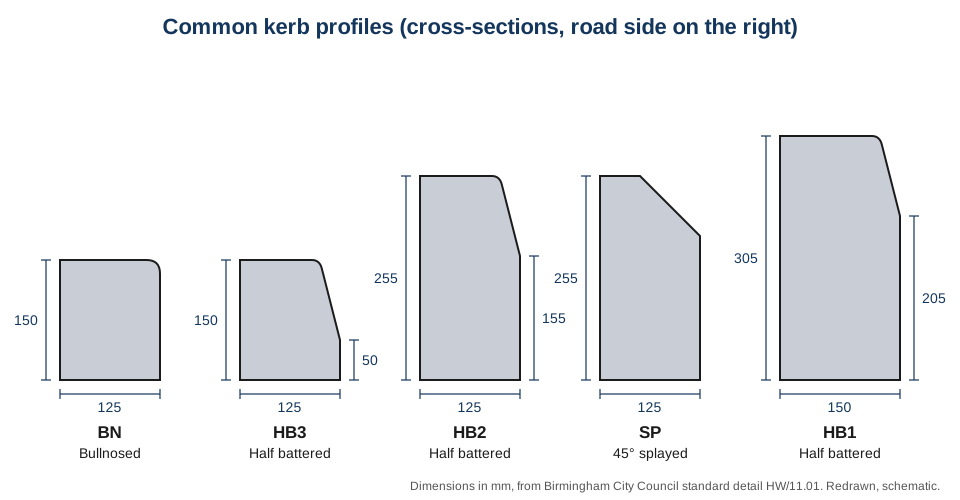
Precast concrete kerbs come in standard shapes (profiles), each with a short code that appears on council specifications, drawings and contractors' quotes. Birmingham City Council's standard detail HW/11.01 shows the common ones, with a note that kerbs must be to BS EN 1340, the standard for precast concrete kerb units. These are the sizes it gives, in millimetres:
| Code | Name | Size (width x height) | Shape | Where you see it at a dropped kerb |
|---|---|---|---|---|
| BN | Bullnosed kerb | 125 x 150 mm | Rounded top front edge (16 to 19 mm radius) | The low kerbs across the opening: Bath and North East Somerset specifies 150 x 125 mm BN kerbs and Coventry 125 x 150 mm BN dropped kerbs |
| HB2 | Half battered kerb | 125 x 255 mm | 155 mm vertical face, then a sloping (battered) face at 12.5 to 15 degrees, rounded top edge | The full-height kerbs either side, in Coventry's detail |
| HB1 | Half battered kerb | 150 x 305 mm | 205 mm vertical face, battered above | A larger version of HB2 |
| HB3 | Half battered kerb | 125 x 150 mm | 50 mm vertical face, battered above | A smaller version of HB2 |
| SP | 45 degree splayed kerb | 125 x 255 mm | 75 mm x 75 mm splay (bevel) on the top front edge | Full-height kerb on some roads; pairs with DL2/DR2 droppers |
Other councils use similar sizes. Cheshire East's crossing specification asks for new kerbs that are hydraulically pressed 125 mm x 255 mm or 125 mm x 150 mm. A single council's sizes can differ from these, so treat the table as a guide to the codes, not a specification for your road.
Dropper and transition kerb types
A dropper kerb is made to fit one particular pair of profiles, and each comes in a left-hand and a right-hand version for the two ends of the crossing. Birmingham's standard detail lists three pairs:
| Left-hand | Right-hand | What it joins | Height change |
|---|---|---|---|
| DL1 | DR1 | Dropper kerb type 1: half battered to bullnosed (for use with kerb types BN and HB) | 255 mm down to 150 mm |
| DL2 | DR2 | Dropper kerb type 2: 45 degree splay to bullnosed (for use with kerb types BN and SP) | 255 mm down to 150 mm |
| TL | TR | Transition kerb: half battered to 45 degree splay (for use with kerb types SP and HB) | 255 mm to 180 mm |
In practice: Coventry's domestic crossing detail shows Type DL1 and DR1 dropper kerbs between HB2 full-faced kerbs and BN dropped kerbs, and Bath and North East Somerset asks for 2 precast concrete dropper (DL2 and DR2) kerbs at the ends of the crossing with BN kerbs in between. Cheshire East says "purpose made dropper kerbs shall be used to reduce the full kerb level on either side of the crossing". Knowsley and Sefton give each tapered or dropper kerb as 0.9 m long.
How high the kerb stays: the 25 mm upstand
A driveway dropped kerb isn't laid flush with the road. The low kerbs keep a small step, called the upstand or kerb face:
- Bath and North East Somerset lays its BN kerbs "to ensure a vertical face of 25mm above finished road channel line level".
- Cheshire East says the kerbs are laid across the crossing "to give a 25mm upstand".
- The Department for Transport's tactile paving guidance says that at all vehicle crossovers, a minimum 25 mm upstand should be provided between the carriageway and the crossover, to help make sure people with a visual impairment don't walk into the road by mistake. That's also why there's no blister paving at a house driveway.
A pedestrian dropped kerb (a crossing point for wheelchairs, mobility scooters and prams) is built differently. The same DfT guidance says its base should preferably be flush with the carriageway, but can have a maximum upstand of 6 mm if there's a rounded bullnose where it meets the road. See requesting a pedestrian dropped kerb and dropped kerbs and disabled access.
Can ordinary kerbs just be laid lower? Cheshire East says "standard kerbs laid flat may be allowed as dropped kerbs under special circumstances approved by the Highways Service".
How many kerbs is a standard dropped kerb?
We checked 17 councils that state how many kerbs a standard single crossing has. 13 of them describe it as 3 low kerbs plus 2 dropper or taper kerbs, 3 as 4 low kerbs plus 2 droppers, and Peterborough allows three or four low kerbs. Where councils give lengths, a standard 5-kerb crossing is about 4.5 m (Knowsley and Sefton 4.5 m, Dudley 4.57 m, Sandwell 4.6 m). Wider crossings are allowed by many councils, but with limits: see widening a dropped kerb and dropped kerb rules and sizes.
| Council | Low kerbs | Dropper / taper kerbs | What the council says |
|---|---|---|---|
| Nottinghamshire | 3 | 2 | A standard access is 5 kerbs: 3 dropped kerbs and 2 transition kerbs. (source) |
| Bradford | 3 | 2 | Standard single crossing: 3 flat kerbs and 2 tapered kerbs. Maximum 5 flat kerbs and 2 tapered. (source) |
| BCP | 3 | 2 | A standard sized crossover is 3 dropped kerbs and 2 tapers. (source) |
| Salford | 3 | 2 | Three dropped kerbs with a taper kerb at either side (five kerbs). (source) |
| Sandwell | 3 | 2 | Two tapered kerbs and three flat, which is 4.6 m wide. (source) |
| Walsall | 3 | 2 | Standard crossing: 3 dropped kerbs + 2 tapers. (source) |
| Wolverhampton | 3 | 2 | 3 flat kerbs measuring 2.7 m and two tapers measuring 1.8 m. (source) |
| Knowsley | 3 | 2 | 5 kerbs or 4.5 m: a left-hand tapered kerb (0.9 m), three dropped (low) kerbs (2.7 m) and a right-hand tapered kerb (0.9 m). (source) |
| Sefton | 3 | 2 | 5 kerbs or 4.5 m: a left-hand dropper kerb (0.9 m), three runner (low) kerbs (2.7 m) and a right-hand dropper kerb (0.9 m). (source) |
| Dudley | 3 | 2 | Five kerbs, 4.57 m long: one left riser kerb, one right riser kerb and three bull-nose kerbs. No more than seven dropped kerbs per household. (source) |
| Neath Port Talbot | 3 | 2 | A left-hand dropper, a right-hand dropper and 3 drop kerbs. (source) |
| Aberdeenshire | 3 | 2 | Up to 3 dropped kerbs and 2 tapered kerbs. (source) |
| Milton Keynes | 3 | 2 | 5 m at the roadside: 3 m of flat kerbs and 2 tapers. (source) |
| Bath and North East Somerset | 4 | 2 | 4 dropped kerbs and 2 dropper kerbs (tapered kerbs). (source) |
| Carmarthenshire | 4 | 2 | 4 dropped kerbs and 2 transition kerbs. (source) |
| Norfolk | 4 | 2 | Lower part of the crossing normally 3.66 m, or 4 dropped kerbs, excluding the dropper kerbs at each end. (source) |
| Peterborough | Three or four low kerbs wide for a single crossing (six to eight if shared). (source) |
A few councils describe their standard by width instead. Shropshire says its standard is 2.75 m at the carriageway edge with a transition or dropper kerb either side, and West Lothian gives its maximum as 7.2 m, "equivalent to 6 kerbs and two transitions". Check your own council on our council finder.
Edgings at the back of the crossing
Narrow edging kerbs, laid flush with the surface, hold the edges of the rebuilt footway where it meets a verge or your drive:
- Bath and North East Somerset: any boundary of the crossing with a grass verge or private driveway has 150 mm x 50 mm precast concrete (EF) edgings.
- Cheshire East: precast concrete edgings 200 mm x 50 mm or 150 mm x 50 mm with flat tops, laid with their tops flush with the footway.
- Coventry: Type EF1 50 x 150 square edgings and Type EBN1 50 x 150 bullnosed edgings on a crossing over a grass verge.
Radius and quadrant kerbs
Where the kerb line curves, ordinary straight kerbs aren't used. Cheshire East says radius kerbs are used for radii of less than 12 metres. Birmingham's standard detail also shows quadrants (quarter-circle corner kerbs) in 305 mm and 455 mm sizes, in bullnosed (QBN), half battered (QHB) and 45 degree splayed (QSP) profiles to match the kerbs next to them. If your crossing is near a corner, the council may refuse it on junction distance grounds anyway: see the rules on junctions.
Concrete or natural stone kerbs
Most council crossing specifications are written for precast concrete kerbs to BS EN 1340 (Bath and North East Somerset and Birmingham both name it). Natural stone is a matter for the council:
- Cheshire East: "Stone kerbs shall be as approved by the Highways Service."
- Knowsley: its standard finishes are bitmac, concrete paving flags, block paving or concrete, but "other materials may exist in conservation areas i.e. setts", and the finish is decided by its highway officers.
- Edinburgh: original historic kerbs and channels, and those replaced in high-quality schemes, are either whinstone or granite, though in many contexts concrete kerbs and channels are acceptable.
- North Yorkshire has a standard detail for a conservation-type granite sett kerb, which says the transition from full face to a dropped kerb crossing is carried out over a one metre length.
If you live in a conservation area or next to a listed building, you may need planning permission as well as the highway authority's consent: see planning permission for a dropped kerb.
Does the number of kerbs change the price?
Yes, at councils that price by the kerb. A wider crossing means more low kerbs, and the dropper kerbs are needed whatever the width:
- Worcestershire: £90.57 per kerb plus £157.02 per square metre of new construction. It says a standard installation with a 1.5 m wide footway or verge and 5 kerbs costs approximately £1,433.74 plus VAT (prices for works completed by 31 March 2027).
- Neath Port Talbot: £2,292 for a standard dropped kerb (a left-hand dropper, a right-hand dropper and 3 drop kerbs), and £250 for each additional kerb.
- Walsall: about £1,750 (footway 1.5 to 2.0 m) or £2,000 (2.0 to 2.5 m) for a standard crossing of 3 dropped kerbs and 2 tapers, and about £1,050 to £1,200 to extend an existing crossing by 2 dropped kerbs and 1 taper (guide prices if its contractor builds it).
Obstacles can add more than the kerbs: Neath Port Talbot says costs will increase if it needs to move street lights, utility boxes, cables or trees. For the full picture, see how much a dropped kerb costs and our cost calculator.
Kerb ramps are not a dropped kerb
Plastic or rubber ramps placed against the kerb don't replace the council's permission. Knowsley lists the "use of a ramp placed at the edge of the road to help drive over a kerb" among the actions that are unlawful and may lead to enforcement or legal action, and West Lothian says "the use of ramps or other obstructions on the road is not acceptable". See dropped kerb without permission and how to apply.
Questions people ask
What kerbs are used for a dropped kerb?
Usually low bullnosed kerbs across the driveway opening, with a dropper (taper or transition) kerb at each end that slopes down from the full-height kerbs either side. Bath and North East Somerset, for example, specifies 150 mm x 125 mm bullnosed (BN) kerbs between a DL2 and a DR2 dropper kerb, all to BS EN 1340. Your council's specification decides the exact types.
What is a dropper kerb?
A tapered kerb that makes the change in height between a full-height kerb and the low kerbs of a crossing. They come in left-hand and right-hand versions: Birmingham's standard detail lists DL1/DR1 (half battered to bullnosed) and DL2/DR2 (45-degree splay to bullnosed). Councils also call them taper, transition, riser (Dudley) or ramp kerbs (Suffolk). Knowsley and Sefton give each one as 0.9 m long.
What does HB2 mean on a kerb?
HB2 is a half battered kerb, the common full-height road kerb with a sloping front face. Birmingham's standard detail gives it as 125 mm wide by 255 mm high. HB1 (150 x 305 mm) and HB3 (125 x 150 mm) are bigger and smaller versions.
What is a bullnose kerb?
A kerb with a rounded top front edge. Birmingham's standard detail gives type BN as 125 mm wide by 150 mm high, with a 16 to 19 mm radius. It's the kerb usually laid low across a dropped kerb: Coventry's crossing detail shows 125 x 150 mm BN kerbs as the dropped kerbs.
How high should a dropped kerb be above the road?
For a driveway crossing, Cheshire East and Bath and North East Somerset both specify a 25 mm upstand, and DfT guidance says every vehicle crossover should have an upstand of at least 25 mm so that people with a visual impairment can tell where the pavement ends. A pedestrian crossing point is different: preferably flush with the road, with no more than 6 mm and a rounded bullnose.
How many kerbs is a standard dropped kerb?
Most of the councils we checked describe a standard driveway crossing as 3 low kerbs plus a dropper kerb at each end (5 kerbs, about 4.5 m: Knowsley and Sefton give 0.9 m for each kerb). A few use 4 low kerbs plus 2 droppers, such as Bath and North East Somerset and Carmarthenshire.
Can I use natural stone or granite kerbs?
Only if your council agrees. Cheshire East says stone kerbs must be approved by its highways service, and Knowsley says other materials such as setts may be used in conservation areas, with the finish decided by its highway officers. In Edinburgh, original historic kerbs are whinstone or granite.
How much does each extra kerb cost?
It depends on the council. Worcestershire's price list is £90.57 per kerb plus £157.02 per square metre of new construction (plus VAT, for works completed by 31 March 2027), and Neath Port Talbot charges £250 for each kerb beyond its standard crossing.
Sources (official, checked 22 October 2026)
- Birmingham City Council: Standard detail HW/11.01 Rev E, Kerb types (PDF drawing)
- Coventry City Council: Standard detail SD 11.12, Domestic vehicular footway crossing over grass verge (PDF drawing)
- Bath and North East Somerset Council: Dropped kerb application, schedule of conditions (PDF)
- Cheshire East Council: Vehicular crossing application and specification, October 2019 rev 1 (PDF)
- Knowsley Council: Vehicle Crossing Policy, April 2025 (PDF)
- Sefton Council: Vehicle crossings policy and installation criteria 2026 (PDF)
- DfT: Guidance on the use of tactile paving surfaces (2021, published January 2022), PDF
- North Yorkshire Council: Standard detail B2-1 Rev C, Conservation type granite sett kerb unit (PDF drawing)
- City of Edinburgh Council: Edinburgh Street Design Guidance, factsheet M1 Footway materials and surfacing (2017, PDF)
- Nottinghamshire County Council: Request a dropped kerb
- Bradford Council: Dropped kerbs and crossovers
- BCP Council: Apply for a dropped kerb
- Salford City Council: Dropped kerbs
- Sandwell Council: Dropped kerb terms and conditions (PDF)
- Walsall Council: Get a dropped kerb for your home, choose who builds it
- City of Wolverhampton Council: Dropped kerbs
- Dudley Council: Vehicle crossing (dropped kerbs)
- Neath Port Talbot Council: Apply for a dropped kerb
- Aberdeenshire Council: Dropped kerbs
- Milton Keynes City Council: Vehicle crossing FAQs (2022, PDF)
- Worcestershire County Council: Apply for a vehicular dropped kerb
- Carmarthenshire County Council: Vehicle access (dropped kerb)
- Norfolk County Council: Apply for a vehicle access crossing (dropped kerb)
- Peterborough City Council: Creating a new vehicular access
- Shropshire Council: Dropped kerb information for applicants (PDF)
- West Lothian Council: Vehicle access (dropped crossing)
- Suffolk County Council: Dropped kerb criteria
- Brighton & Hove City Council: Vehicle crossover review criteria