Pedestrian dropped kerbs: requesting a crossing, not a driveway
A pedestrian dropped kerb is a crossing point so wheelchair, mobility scooter and pram users can get across the road. It is not a driveway dropped kerb. To request one, ask your council's highways team. There is usually a limited budget and no guarantee. If you want a vehicle crossing so you can drive onto your property, that is a different application: see dropped kerbs in Leeds, dropped kerbs in Plymouth, or find your council.
Last reviewed: Edited by our editor
Quick answer. Write to or use the online form of your highway authority (the council that looks after the road), say exactly where you need to cross and why, for example "I use a wheelchair and there's no dropped kerb between X and Y". Leeds prioritises places with no suitable alternative route and says work can take around 6 months; Plymouth needs your local councillors' approval. This is different from a driveway dropped kerb, which you apply and pay for yourself.
What a pedestrian dropped kerb is
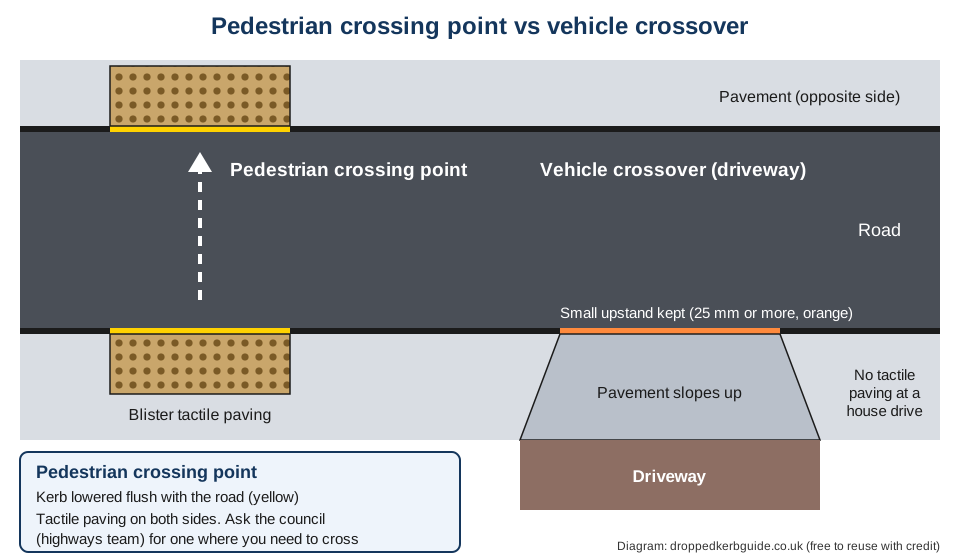
It's a place where the kerb is lowered so people can cross the road without a step: wheelchair and mobility scooter users, people with prams and pushchairs, and people who find kerbs difficult. Unlike a driveway vehicle crossover, it's flush with the road and has tactile paving so people with a visual impairment know where the pavement ends.
What DfT guidance says
The Department for Transport's Inclusive Mobility guidance (December 2021) says level access at all road crossings is essential, particularly for wheelchair users. Key points:
- On longer side roads and residential roads, consider dropped kerbs at least every 100 metres where possible, so people don't make long detours, and take account of where pedestrians actually want to cross.
- Dropped kerbs should preferably be flush with the road, with a maximum 6 mm tolerance if not, and a rounded bullnose at the change of level.
- The approach slope shouldn't exceed 1 in 12, and 1 in 20 where space allows; side transitions no steeper than 1 in 11.
- The flush part should be at least 1,200 mm wide (3,000 mm where many people cross), and 1,000 mm next to disabled parking spaces.
- At the foot of the dropped kerb, the road camber should be no more than 1 in 20 for 600 mm from the kerb, so a wheelchair's footrests don't catch.
This is best-practice guidance for councils, not a legal right to a crossing at a particular spot, but it's useful to quote in your request.
Tactile paving
The DfT guidance on tactile paving (2022) sets out the blister surface used at crossing points:
- Controlled crossings (with signals): red blister paving, which shouldn't be used anywhere else.
- Uncontrolled crossings: usually buff, but any colour except red, as long as it contrasts with the surroundings.
- Driveways: blister paving should not generally be laid on vehicle crossovers to homes. Instead, every vehicle crossover should keep an upstand of at least 25 mm between the road and the crossover so people with a visual impairment don't walk into the road by mistake. Busy accesses, such as to supermarkets or petrol stations, may be treated as crossings.
How to request one
- Find your highway authority with the postcode checker (in two-tier areas, the county council).
- Look for a form. Leeds has one to report high kerbs that are a barrier and pinpoint where you're trying to cross. Plymouth takes requests by email.
- Be specific: the exact location (a map link or nearest house numbers), the journey you're trying to make (to a bus stop, shop or GP surgery), who is affected and how, and whether there's any alternative route.
- Ask a councillor to support it. Plymouth needs approval from your local councillors and has a limited amount of money in each ward.
- Expect a wait. Leeds says an engineer will visit, works can take around 6 months, and there's no guarantee for each request. In Leeds, dropped kerbs are added automatically when a street is fully refurbished.
Leeds is clear that its accessible kerb service isn't for a driveway crossing or adaptations in front of a private property. Plymouth will drop the pavement near your home to make it easier to reach your property, for a charge depending on the size of the access. For a driveway, see dropped kerbs and disabled access.
If cars block it
Highway Code rule 243 tells drivers not to park where the kerb has been lowered to help wheelchair users and powered mobility vehicles; in Scotland you MUST NOT park where the kerb is lowered to help pedestrians or cyclists. In England and Wales, where councils enforce parking, section 86 of the Traffic Management Act 2004 makes it a contravention to park next to a dropped footway. Report it to your council's parking team. More: parking across a dropped kerb.
Questions people ask
Who do I ask for a pedestrian dropped kerb?
Your highway authority: the council that looks after the road (in two-tier parts of England, the county council). Use our council finder. Leeds and Plymouth both take requests from residents.
Is there a charge for a pedestrian dropped kerb?
For a crossing point on a public route, the councils we checked don't mention a charge to the person asking: Leeds runs an improvement programme and Plymouth uses a limited budget in each ward. Plymouth does charge if you ask it to drop the pavement near your home to make it easier to get to your property, depending on the size of the access.
Why is there no tactile paving at my neighbour's driveway?
DfT guidance says blister paving should not generally be laid on vehicle crossovers to homes, or where traffic using an access is low. Instead it asks for a kerb upstand of at least 25 mm at every vehicle crossover so that people with a visual impairment don't walk into the road by mistake.
What colour should tactile paving be at a crossing?
Red blister paving is for controlled crossings (with signals) only. At uncontrolled crossings it's usually buff, though any colour other than red can be used as long as it contrasts with the surroundings (DfT tactile paving guidance).
Sources (official, checked 14 October 2026)
- DfT: Inclusive Mobility, a guide to best practice on access to pedestrian and transport infrastructure (December 2021), PDF
- DfT: Guidance on the use of tactile paving surfaces (published 10 January 2022), PDF
- GOV.UK (DfT): Inclusive mobility: using tactile paving surfaces
- The Highway Code: Waiting and parking (rules 238 to 252), rules 243 and 244
- Traffic Management Act 2004, section 86 (parking at dropped footways)
- Transport (Scotland) Act 2019, section 56 (dropped footway parking prohibition)
- Leeds City Council: Report the need for an accessible kerb in your local area
- Plymouth City Council: Dropped kerbs (including crossings for wheelchairs and mobility scooters)
- GOV.UK (DfT): The Blue Badge scheme: rights and responsibilities in England